Full Moon Kundalini Meditation on the beach

Behind Hollywood Cultural Arts center on the beach

1301 S Ocean Dr
Hollywood, FL 33019

How to find us: A1A turn onto Azalea terrace park behind the Cultural Center and walk onto beach. Look for the people wearing white

Every Full Moon the Kundalini Miami Yoga Instructors put together a wonderful gathering on the beach in honor of the Full Moon.
The full moon is a perfect time to channel the fullness of emotions to devotion and open our heart centers.
Join us for an evening of kundalini yoga and meditation, and by the time we’re done the Moon is just rising and since we sit facing the ocean we have front row view, its just beautiful!

Lead by spiritual master and yogini Jiwan Kaur www.jiwanyoga.com

Join us! 6pm-7pm to chant, elevate, and open our hearts to ourselves & ALL souls on our planet (and those waiting to come as well!!)

Behind Hollywood Cultural Arts center on the beach.
1301 S Ocean Dr. On A1A turn onto Azalea terrace park behind the Cultural Center and walk onto beach.
Look for the people wearing white. smile

Bring water, a yoga mat and/or blanket to lay on the sand, and coins for parking.

Donations welcomed

**if rain event is canceled**

For more information, questions, comments or feedback about this event please contact:

Jiwan kaur
www.jiwanyoga.com
954-445-6775

“The energy of the universe is yours, it is your birthright, just claim it!” –Yogi Bhajan

Benefits of Meditation

17 Benefits of Meditation

Meditation results in holistic health. It gives good health on the physical, mental and emotional levels. Specific health benefits reported by some who meditate are:

1. The stabilization of high or low blood pressure, blood sugar, body heat and
heartbeat.

2. The balancing of mind/body rhythms.

3. Reduction of muscle tension, stronger bones, immunity from disease.

4. Cleansing – quicker elimination of toxins and body waste.

5. Overcoming insomnia and improved quality of sleep.

6. Enhanced energy, increased work capacity.

7. Longer life span – improved body metabolism and body cells with a longer life span.

8. Secretion of healthy body chemicals – increased secretion of natural anti-depressants, enhanced secretion of endorphins, the body’s ‘happy chemicals’.

9. Relationships – Meditation inherently puts you in tune with yourself and others. The direct result of this is deeper, more meaningful interpersonal relationships with family, friends and with everyone you encounter in your daily life.

10. Intelligence – To work efficiently, one needs intelligence. Meditation ignites your innate intelligence making you more aware and sharp. The natural result of this is improved, efficient and effortless performance in whatever you do.

11. Creativity – Each of us holds within us an undiscovered treasure of talent and potential. Meditation reveals and helps you realize your inner talents and latent creativity.

12. Authenticity – Meditation allows you to touch base with the real you, and makes you realize your uniqueness. Self-confidence then becomes a natural by-product.

13. Balance – Most of us live life as a roller-coaster ride, held in the sway of emotions like worry, jealousy, discontentment, fear, anger, guilt, etc. over which we have no control. Meditation enables you to be centered in yourself, have a solid inner balance and thus be the master of your own self.

14. Relaxation, peace, bliss – A natural byproduct of meditation is something we spend almost a lifetime trying to attain: inner relaxation and peace. With meditation, you automatically drop out of the vicious cycle of fear, greed and stress, and enter the virtuous cycle of bliss.

15. Holistic spiritual growth – To measure intellect, we have IQ or Intelligence Quotient, which is measured by many standardized tests. Of late, another measure is gaining importance, especially in the corporate world, namely EQ or Emotional Quotient. However, the most important factor of our lives which is inner satisfaction and fulfillment, is what matters at the end of the day. Meditation enhances this very important factor of life – SQ or Spiritual Quotient – besides also increasing IQ and EQ.

16. Life – As of now, our mental setup is rigid and reflects our personality. Because of this self-image we carry in our minds, we face a lot of troubles in life and are not able to enjoy life completely. Meditation simply reprograms the software of the mind so that we can live life completely.

17. Ultimate potential – You are like an airplane with the potential to fly, but you think you are an ox-cart because you have not actualized your potential. Meditation simply makes you realize and experience who you really are and the enormous capabilities you are born with.

by InnerAwakening.org

Haiti Fundrasier

KUNDALINI YOGA & HEALING MEDITATION FUNDRAISER
Efforts Relief For Haiti

Please join us at Temple Beth El Tuesday, January 26th 7-8pm for kundalini yoga and a healing meditation to raise funds for those in Haiti.

Temple Beth El
1351 S 14th Ave, Hollywood Fla 33020

As some of you know the temple along with First Presbyterian church has funded together an orphanage in Haiti. Together they have provided housing, food and education to many children. So let us all gather and vibrate to them healing, love and support.

LOVE is an energy
LOVE is a power
LOVE is a strength
LOVE is a totality.
LOVE has no fear and no vengeance
LOVE has every answer.
— Yogi Bhajan

Donations: please make checks out to Temple Beth El and write in memo Haiti.
All monies will go directly to Haiti relief funds. Please consider a minimum donation of $10.00 for the evening.
Kindly forward to all you know.

Any questions please contact Jiwan Kaur www.jiwanyoga.com 954-445-6775

Thank you.

Temple Beth El
1351 S 14th Ave
Hollywood Fla 33020

Directions: please take 95 exit Pembrook Rd continue east to US1 cross US1 and continue to 14th ave take a left onto 14th ave and Temple will be on Left hand side between Wiley and Rodman St..

You may also reach the Temple from Hallendale Beach Blvd going east to 14th Ave take a right ( traveling North) continue straight until you see Temple on Left about 5 miles or so.. you must pass Atlantic Shores Blvd.

darkness_to_light

December and the Holiday Season

darkness_to_light

The major holidays of the month of December tend to become the focus of many people’s lives to the point which people schedule their activities around them. Some of us become so busy and stressed that we forget to honor ourselves and take time to relax and reflect upon our lives and what really matters to us. During this time of renewal all things should be considered, and we can use this season of celebration not only to acknowledge the light but the darkness as well.
In some cultures, the winter Solstice marks the returning of the light making this a good time for contemplation and meditation, and a chance to soul-search. Since ancient times, some cultures have taught that light is good and dark is bad, but in this era of awakening we’ve learned in fact that this is a limited way of thinking since Light and Dark create a perfect balance. We need to stop seeing them as “good” or ‘bad”, they are just different, complementary, and necessary.
When we close our eyes to rest, to meditate, what we see is darkness, the darkness inside of us, which is infinite space within the finite body. Bill Plotkin describes in Soulcraft the journey of spirit as an ascent and the journey of soul as a descent into the depths of the self, “Soul embraces and calls us towards what is most unique in us. Spirit encompasses and draws us towards what is most unversal and shared.” ..so this time of the year celebrate both!

This December we have a Blue Moon, December 31st is the second full moon of the month, just as the year ends. this is a perfect time to honor new beginnings.

Meditation Practice

Find a place that will be completely dark when the lights go out. Prepare by having a candle and lighter or matches before you. Sit on the floor or at a table, and ground yourself, prepare the sacred and safe space. When you’re ready, turn off the lights. Sit in complete darkness and silence, and begin by visualizing the descent into your self. Do not feel frightened, remember you are in a safe space and what you’re feeling is the unexplored territory.
You can visualize descending a flight of stairs if you like, taking you deeper into your inner realms. Knowing you cannot get lost helps you get rid of your fear, remind yourself that you can light the candle whenever you choose. Look deeply inside yourself. Be honest. This is a secret place that no one else needs to know about. Investigate; examine memories, usually they are accompanied by feelings, emotions. If something does frighten you, light the candle. If not, light it when you are finished. Imagine the candle as the ascent upward from your journey, shedding light on what you learned, and bringing balance by adding light to darkness. This light illuminates the dark the way the spirit illuminates the soul.
You can come back and explore again any time you wish, and you should. Become a regular visitor, pretend you are an explorer. Draw or write about the landscape of your soul. Dig deep and find the roots of why you have the opinions you hold and how you came to the path you are on. What do you need? What do you want? Ask the tough questions. Just because you ask doesn’t mean you have to make an immediate change in your life; this process takes a lifetime of study. We are always changing and reinventing ourselves. Discover who you are and why. And watch yourself continue to change and grow.
Spirit connects us; soul sets us apart. Soul-searching is an investigation of our mysteries, a journey of self-discovery. There is a balance to be found in celebrating the yin and yang, dark and light, spirit and soul, the universal and the personal.
in this month of celebrating light, join together with others, and don’t forget to celebrate the darkness as well – the beautiful, often hidden mysteries of your soul.The process will enrich your personal life and your relationships. To reach our greatest potential we must grow, both toward the light that unites us, and toward the mystery that keeps us unique.

by Ember, Llewellyn Worldwide

meditating hands

About Meditation

The mind is ever active. Whenever you make time to have a few moments to yourself, you end up getting distracted by the worries and problems of the earthly life. Thoughts like whether you are doing the right thing, or where you are headed, how to make more money, how you will get ahead at work, and a million other things keep getting in the way. To take charge of your life, an effective way to approach these problems without overwhelming yourself is to spend some quiet time with your mind, when the part that is often unused can take over, and give yourself the joy of becoming aware of the infinite abundance the Universe blesses us with daily. Prepare yourself to accept with an open heart the new thoughts, ideas and the gifts of love, harmony and balance you are about to receive.
In the art of meditation there are techniques used to assist in stress relief, insomnia, anxiety and emotional distress. It’s great for studying and concentrating as it aids in memory, and its a wonderful treat for the soul. There are many wonderful rewards behind the practice of Meditation. Discover them!
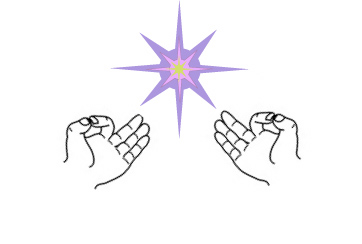
meditating hands

    ~ Meditate ~

  • Close your eyes -knowing (telling yourself) this will only take a few minutes of your time.
  • Breathe deeply.
  • Calm your mind and relax your body: Connect with your surroundings, then gently shift your focus to hear the silence within you. First your body, then your mind. Listen with love.
  • Breathe deeply.
  • Dismiss distractions by focusing on relaxing your body. Part by part surrender to the weight of your body.
  • Let your consciousness expand, with any limits. Let it do what It knows to do, and just flow.
  • When thoughts arise, gently filter them away from the forefront of your mind. Allow them to shift to the back of the mind. As if a TV was on in another room, you can hear it, but it does not distract you.
  • Keep your heart and mind open to the infinite possibilities the universe constantly sends your way.
  • Be willing and accepting, without judgment.

Meditation -like yoga- originated in Vedic Hunduism many centuries ago, and it was much later adopted into a wide variety of practices of religious and non-religious formats which emphasize mental activity or quiesscence.
The English word comes from the Latin meditatio, which originally indicated every type of physical or intellectual exercise, but which later could perhaps be better translated as “contemplation”.
When we meditate we are allowing our brain to function in ways that it does not do so when the conscious mind is awake. It is when we quiet the most active part of our mind and yield to the inspiring world of our subconscious. The goals we wish to achieve when we meditate are various, beginning with spiritual enlightenment, to the transformation of attitudes, to better cardiovascular health and for the union of our energy body with the energy of the Universe. The benefits are endless, including an unlimited source of health and well-being, and overall balance and abundance.

The following are some fundamental definitions of Meditation:
– a state that is experienced when the mind dissolves and is free of all thoughts
– focusing the mind on a single object (such as a religious statue, or one’s breath, a mudra or a mantra)
– a mental “opening up” to the divine, invoking the guidance of a higher power
– reasoned analysis of religious teachings

These practices are found within Eastern religions as well as some secular contexts, such as the martial arts. A man called Edgar Cayce taught that “Through prayer we speak to God. In meditation, God speaks to us”.
From the point of view of psychology, meditation can induce an altered state of consciousness.
It is easy to observe that our minds are continually thinking about the past (memories) and the future (expectations). With intention it is possible to slow down the mind. We are able to observe a mental silence, also called experience of the present moment. This is a subjective sense of being connected with the universality of being. Meditation is the method one may follow to verify this experience. It is an experiential means of separating thoughts from the part of our consciousness which perceives the thoughts, the observer. By disengaging our mind we are able to observe the more subtle details and gain better control over what we give attention to. The experience of thoughts winding down and stopping is also known as timeless awareness.

TYPES OF MEDITATION
According to research, the different types or techniques of meditation can be classified according to their focus. That is, whether they focus on the field or background perception and experience, also called mindfulness, or whether they focus on a preselected specific object, also called “‘concentrative’ meditation.” There are also techniques that shift between the field and the object.
Meditation, to reflect on the translation of “contemplation,” is also a method of essay or contemplative writing in which one does continuous and profound contemplation or musing on a subject or series of subjects of a deep nature.
There is also “outward meditation” (when we open up and send energy out and receive “visions”) and “inward meditation” (when you concentrate on and visualize something that you desire, like recreating the Safe Place.

While meditation focuses on mental or psycho-spiritual activity, this is of course only one of several spheres of human existence; and we are social beings as well as individuals. Most traditions address the integration of mind, body, and spirit (this is a major theme of the Bhagavad-Gita); or that of spiritual practice with family life, work, and so on.

THE ENVIRONMENT & OTHER IMPORTANT DETAILS
The immediate meditative environment is often held to be important.
A well equipped Dojo is not necessary, just as long as the space to use is clean and free of any type of clutter.
Quiet is often held to be desirable, and some people use repetitive activities such as deep breathing, humming or chanting to help induce a meditative state. During the time of meditation it is strongly recommended to disconnect or turn off any phones, tv and radio. However, if music is desired during the practice see that it is soft, relaxing music that will inspire tranquility and love, as sound is also another tool many meditators/practitioners like to use.
There exist other details that are shared by more than one religion. One example would be “navel-gazing,” which is apparently attested within Eastern Orthodoxy as well as in Chinese Qigong practice. Another would be the practice of focusing on the breath, which is found in Orthodox Christianity, Sufism and numerous Indic traditions.
Even regular mundane tasks are to invite a moment of meditation, for example when we come in any type of contact with water.
If at all possible, place a nice, green, healthy plant nearby. Water is also a good omen to have around, specially if its running water like a water fountain, a candle and incense are also beneficial. These components represent the elements of Earth, Water, Fire and Air.
Posture is also an important step in the practice of meditation.
Purpose drives us to practice meditation and focusing on the intention is what helps achieve a successful meditation session.

PURPOSES AND EFFECTS OF MEDITATION
The purposes for which people meditate vary almost as widely as practices. Meditation may serve simply as a means of relaxation from a busy daily routine; as a technique for cultivating mental discipline; or as a means of gaining insight into the nature of reality, or of communing with one’s God. It has been reported improved concentration, awareness, self-discipline and equanimity through meditation. Also an increase in patience, compassion, and the understanding of other virtues and morals. Feelings of calm or peace, and/or moments of great joy. Experience of spiritual phenomena such as Kundalini, extra-sensory perception, or visions of deities, saints, etc.
Some people have even experienced “Miraculous” abilities such as levitation (or also called yogic-flying).
Some traditions acknowledge that many types of experiences and effects are possible, but we must keep in mind the spiritual purpose of the meditation, and not be distracted by lesser concerns. For example, Mahayana Buddhists are urged to meditate for the sake of “full and perfect enlightenment for all sentient beings” (the bodhisattva vow).

HEALTH APPLICATIONS AND CLINICAL STUDIES OF MEDITATION
In the recent years there has been a growing interest within the medical community to study the physiological effects of meditation. Many concepts of meditation have been applied to clinical settings in order to measure its effect on somatic motor function as well as cardiovascular and respiratory function. Also the hermeneutic and phenomenological aspects of meditation are areas of growing interest. Meditation has entered the mainstream of health care as a method of stress and pain reduction. For example, in an early study in 1972, transcendental meditation was shown to affect the human metabolism by lowering the biochemical byproducts of stress, such as lactate, decreasing heart rate and blood pressure and inducing favorable brain waves.
As a method of stress reduction, meditation is now often used in hospitals all over the country in cases of chronic or terminal illness to reduce complications associated with increased stress including a depressed immune system. There is a growing consensus in the medical community that mental factors such as stress significantly contribute to a lack of physical health.
According to research – Dr. James Austin, a neurophysiologist at the University of Colorado, reported that Zen meditation rewires the circuitry of the brain. This has been confirmed using sophisticated imaging techniques which examine the electrical activity of the brain.

Dr. Herbert Benson of the Mind-Body Medical Institute, which is affiliated with Harvard and several Boston hospitals, reports that meditation induces a host of biochemical and physical changes in the body collectively referred to as the “relaxation response” (Lazar et.al, 2003). The relaxation response includes changes in metabolism, heart rate, respiration, blood pressure and brain chemistry. Benson and his team have also done clinical studies at Buddhist monasteries in the Himalayan Mountains.
Among other well-known studies within this particular field of interest we find the research of Jon Kabat-Zinn and his colleagues at the University of Massachusetts who have done extensive research on the effects of mindfulness meditation on stress (Kabat-Zinn et.al, 1985; Davidson et.al, 2003)

MEDITATION AND THE BRAIN
Mindfulness meditation and related techniques are intended to train attention for the sake of provoking insight. Think of it as the opposite of attention deficit disorder ADD. A wider, more flexible attention span makes it easier to be aware of a situation, easier to be objective in emotionally or morally difficult situations, and easier to achieve a state of responsive, creative awareness or “flow”.
One theory, presented by Daniel Goleman & Tara Bennett-Goleman (2001), suggests that meditation works because of the relationship between the amygdala and the prefrontal cortex. In very simple terms, the amygdala is the part of the brain that decides if we should get angry or anxious (among other things), and the pre-frontal cortex is the part that makes us stop and think about things (it is also known as the inhibitory centre).
So, the prefrontal cortex is very good at analyzing and planning, but it takes a long time to make decisions. The amygdala, on the other hand, is simpler (and older in evolutionary terms). It makes rapid judgements about a situation and has a powerful effect on our emotions and behaviour, linked to survival needs. For example, if a human sees a lion leaping out at them, the amygdala will trigger a fight or flight response long before the prefrontal cortex knows what’s happening.
But in making snap judgment, our amygdalas are prone to error, seeing danger where there is none. This is particularly true in contemporary society where social conflicts are far more common than encounters with predators, and a basically harmless but emotionally charged situation can trigger uncontrollable fear or anger — leading to conflict, anxiety, and stress.
Because there is roughly a quarter of a second gap between the time an event occurs, and the time it takes the amygdala to react, a skilled meditator may be able to intervene before a fight or flight response takes over, and perhaps even redirect it into more constructive or positive feelings.
Some studies of meditation have linked the practice to increased activity in the left prefrontal cortex, which is associated with concentration, planning, meta-cognition (thinking about thinking), and with positive affect (good feelings). There are similar studies linking depression and anxiety with decreased activity in the same region, and/or with dominant activity in the right prefrontal cortex. Meditation increases activity in the left prefrontal cortex, and the changes are stable over time — even if you stop meditating for a while, the effect lingers.

Meditation and the EEG
Meditation also effects brain wave production as measured by an EEG machine. While the brain at a waking state is primarily in the Beta range of frequencies (14 – 21 cycles per second), while under meditation the brain tends to slow down the Alpha range (7 – 14 cycles per second). One of the first Americans to study the effects of meditation on brainwave production was Jose Silva who founded the Silva Method. Silva theorized that meditation, in addition to stress relief could also be used for enhancing creativity and developing intuition.
Electroencephalographs (EEG) recordings of skilled meditators showed gamma wave activity that gradually expanded across the brain during meditation. Gamma waves indicate synchrony between sections of the brain. These meditators had 10 to 40 years of training in Buddhist-based mental training. EEGs done on meditators who had received recent training turned up considerably less synchrony.
The experienced meditators also showed increased gamma activity while at rest and not meditating. The results of the study do not make clear whether meditation training creates this activity or if individuals with high gamma activity are attracted to meditation. (Antoine Lutz & Richard J. Davidson, 2004)

Indulge in the discipline of Meditation and allow yourself to receive the extraordinary rewards the practice leaves you with.

The Practice of Loving-Kindness

METTA: LOVING KINDNESS MEDITATION

Metta (Pali) or maitra (Sanskrit) has been translated as “loving-kindness”, friendliness, benevolence, amity, friendship, good will, sympathy, “active interest in others.” The cultivation of “metta” is a popular form of meditation in Buddhism.

The object of metta meditation is to experience loving kindness in its pure form (love without attachment). Traditionally, the practice begins with the meditator cultivating loving kindness towards themselves, then their loved ones, friends, teachers, strangers, enemies, and finally towards all sentient beings.

Followers of Buddhism believe that those who cultivate metta will be at ease because they see no need to harbour ill will or hostility. It is also known that Buddhist teachers may even recommend metta meditation as an antidote to insomnia and nightmares. It is generally felt that those around a “metta-full” person will feel more comfortable and happy too. Radiating metta is thought to contribute to a world of love, peace and happiness.

Wikipedia.org

What does all this mean? It means that when we allow our innate energy of Goodwill and Kindliness to emerge and consciously feel it, embrace it and be taken by it we merge with the Creative Field. Words are limited to describe the feeling this experience introduces. Have you tried it yet? Tap into your own benevolence within and swim in this blanket of energy feeling blissful while bringing restoration to the being on every level.

Meditation Meetup Group
For schedule of classes and workshops visit the LoveDriven Calendar

autumn

A Weekend Full Of Magickal Celebration

autumn

In Graceful celebration to honor the Lord & Lady and the Highest Presence of Divine Love we embark in a magickal journey as we feast and dance and rejoice and rite. Samhain is here. The festival of Samhain celebrates the Wiccan New Year.

Saturday, October 31, 2009 -> The 12th Annual Witches Ball at the Unitarian Universalist Church of Ft. Lauderdale

Sunday, November 1, 2009 -> Full Moon Yoga, Meditation & Qigong on the beach

Birthday Comments

Who I Am

by Naomi Sztam


Birthday Comments

~Magickal Graphics~

This is what I read when I forget who I am, please enjoy if it resonates with you too.

You are a beauty within angels who is in this universe for the sake of love and compassion. You are here for the sake of wisdom and healing. You are here to do divine work and even though you easily become distracted, you come back. Keep coming back, for you are one of God’s (or source or highest light or whatever the name, no matter) loyal workers, and he needs you in his busy factory. The factory of heavenly light and heavenly love is where you feel you belong, and here you do belong.

The love within your heart is from this incredible light, if you ever put yourself down by assuming people or circumstances are putting you down, you are putting down the amazing gift that God has given you. A gift is to be treasured. Treasure it with love and dignity. Other people’s words and actions are their words and actions, from their own insecurities, from their own fears, or from just the only best they can give at that moment, even if they don’t understand the consequences their actions have upon others and themselves. Other people’s words are never your identity, NEVER. Value you as you deep down really know who you are. You are more than life itself. You are made of a thousand stars and a million kisses.

You are made of lots of little bones, and lots of funny laughs. You are made of millions of poems and a gentle soul. You are made of luminous things, all wrapped up in one. All wrapped in one- together with your body, mind, soul; you are perfectly here to experience what you need to experience, everything is divine, even the most horrid things people do, even the worst things you see, even the biggest of disasters.

Everything has a divine intent and it is meant for your learning and growth. Grow as you grow, enjoy the rain from the misty clouds and the sunshine from our heavenly sun, and let it bring brightness in your heart, as it is lovely in its absolute just as you are lovely in its absolute; and lovely as your heart receives light from within and around you with grace. So spend the day with ease, you have great protection, deep within your skin, and deep within your soul God is always near.

Enjoy, from my heart to yours! Naomi

The Practice of Gongyo

Gongyo is a japanese word that means “assiduous practice” and refers to a formalized service performed by followers of nearly every Chinese, Korean, and Japanese Buddhist denomination. It is often done once or more times a day and consists of the recitation of a sutra passage or passages, a mantra or matras, or a combination of both. Gongyo can be done at a temple and at home, almost always in front of an object or objects of veneration and accompanied by offerings of light, incense, and food.