Quickening Full Moon

February 9, 2009 – Leo Moon 9:50 am – Lunar Eclipse 9:38 am

Opposite the Moon, the Sun in Aquarius symbolizes concern for humanity, as a whole, to allow freedom of each individual. With the Moon in Leo, there is a strong urge to express oneself. Leo is the sign of the Sun, so shine! This is a wonderful time to lift out of an ordinary mind set, blending your imagination with a heart-centered urge to seek emotional security through self confidence . True self-esteem is built by developing a calm center and taking responsibility for the energy (negative and positive) you output everyday. The issue at hand is to become a radiant and happier person ultimately for the sake of everyone around us. Celebrate this Full Moon as we write, direct and star in our own life story. Bravo!

by Joni Ross, Astrologer/Teacher

Gemini Full Moon

Full Moon – December 12, 2008 11:37am

The Full Moon in December is known by many names depending on the cultural background, Long Nights Moon and Oak Moon are just two of them. [See The Moon for more information]

The Full Moon in Gemini is excellent for divination, rituals to seek inspiration, or brainstorming. You could incorporate all three by using bibliomancy. Take a book about the subject you wish to explore. Open it at random and, without looking, point on the page. Read the sentence your finger landed on. Does the passage give you any new ideas or insights? Repeat 3 or 4 times, eityher with the same book, or different books on the same subject. Meditate on the sentences you have read.
Another way to seek ideas is to invoke the Muses. The 9 daughters of Zeus and Mnemosyne were each attributed to a different art: epic and heroic poetry, music, lyric and erotic poetry, history, tragedy, sacred poetry and geometry, dance, comedy, and astronomy and astrology.
Choose the Muse most relevant to your field. Prepare an altar with symbols of your art or other specialty. Include a picture of the Muses, or your Muse, if you can. Cast a cricle, then ask for help and inspiration. Promise to pursue your art faithfully. Do some artistic work, spend a little time in circle writing, drawing, singing, dancing, or practicing your instrument. –Magenta Griffith

October & Its Festivities

Every being is always receiving that which is a vibrational match to whatever they are offering.
–Abraham-Hicks

Let’s welcome the month of October and let’s celebrate the season!

So, what are you offering? Are you happy with what you’re receiving? As we gently spin away from the Sun, the year slowly shifts into its last quarter and the light is gradually waning down. What are your plans for this month? Are you ready to finish your projects for the year?, or will you carry them over into the new year?
Enter the month of October we are already in full celebration with Ramadan, which comes to its completion on the 2nd. October is my personal favorite month of the year because not only is the celebration of Samhain, most commonly known as Halloween, but it also kicks off the holiday season, and the colorful Autumn season has begun to settle in, that is, in the North, as playful Spring arrives in South. Our look, first hand, at the cycle of birth, death and rebirth.
Interestingly, depending on each cultural belief, this month could bring hard work, or none at all. For example, Yom Kippur, which is on October 9th, is traditionally observed by fasting, prayer, abstaining from physical pleasures, and refraining from work. Yom Kippur is the climax of the Yamim Noraim (“Days of Awe”), and with Rosh Hashanah (at the end of September) forms the Jewish High Holy Days. In accordance with Leviticus 23:27 the date of Yom Kippur is the 10th day of Tishrei (“the tenth day of the seventh month”) in the Hebrew calendar.
Columbus Day is October 13th, Sukkot begins on the 14th, the same day of the Full Moon. This month the Full Moon is in Aries. On the 22nd the Sun enters the eighth house of the Zodiac, the sign of Scorpio; the New Moon is the 28th, the same day the Celtic Tree Month of Reed begins. And on the 31st we celebrate Halloween/Samhain/All Hallows Eve. In the Northern Hemisphere it is still a time of harvest, the last of the year; back in the old days when labor was all done by hand, it meant a lot of hard work, followed by celebration and finally rest.
Samhain is a very important holiday in a Witch’s year. Being a time of reflection, we remember and honor our ancestors; and since it is one of the two times a year when the veil between worlds is the thinnest, we attempt at this time to establish communication with other worlds and those who have crossed.
To those in the Northern half of the world this holiday is about death, completion and transition, when Nature wanes into the end of another cycle, the Winter season, a time to remember all that has died in the course of the year. Life feeds on life. In the Southern Hemisphere October carries in a time of rebirth and renewal, restoring the land and thus maintaining the balance of the Grand Design.

I hope you enjoy the journey this month inspires you to take, as you begin to prepare for new resolutions and setting new goals.
Remember … there are always reasons to engage in joyful celebration. The more celebratory energy you “produce” the more you send off into the air, spreading it throughout the world. This is how we heal the planet, and reduce the negative energies that dwell over it’s green and watery surface. Don’t forget that whatever you celebrate make sure you do exactly that … celebrate! Bring happiness into your life, let the joyful energy surround you, blessing your home, your path, and every choice you make.

SAMHAIN

It is believed that the spirits of the dead remain wandering until Samhain, when they can finally cross to the “other side” to rest, as the passage between the living and underworld is open. With this doorway between worlds slightly ajar, the festival of Samhain is also regarded and respected as a time that allows mischievous and restless spirits to make a temporary return to our world.
On this night, take a symbolic journey to the underworld with a virtual or actual walk in a labyrinth. The mystical labyrinth is believed to be a metaphor for the journey of death and rebirth as you travel through the spiral patterns to the core and return on the same path. If you can visit a labyrinth, take the journey. Or you can mark out a temporary labyrinth on sand, or on the ground with twigs, sting, or tape. As you travel to the center, leave behind thoughts and images that no longer serve you, shedding unnecessary emotional burdens. Upon reaching the center, stop and imagine you have arrived at the underworld where you can communicate with loved ones who have died. On your walk out, focus on the release and rebirth and enjoy the symbolic transformation. –by Emely Flak. Courtesy of Llewellyn Worldwide

Another type of Samhain celebration is a Dumb Supper, a meal eaten in silence, communing with the spirits of those who have died. Traditional foods for the Dumb Supper vary, but they should be the favorite foods of those you plan to honor. Set a formal dinner table, with a tablecloth and your best dishes, as you would for any honored guests. There should be several more places set than living guests attending. The meal should not begin until after dark, and use candles for lighting, not electric lights. Allow the candle to burn until they have gone out. Photos and mementos of those who have died may be placed on the table or someplace else in the room. For the feast itself, people enter the room in silence, serve themselves or pass dishes, and eat without speaking or making any sound if at all possible. Be sure there is a libation plate and bowl; some of each liquid should be put in the bowl, some of each solid food placed on the plate.
Afterward, these should be given to the earth by placing them in a compost heap or burying them in the garden. In this way, many Witches honor their dead and celebrate the harvest at Samhain. –by Magenta Griffith. Courtesy of Llewellyn Worldwide

Click Here for recipes, activities and more information about the magickal holiday of Samhain.

Click Here for a fun Samhain Ritual.

Aries Full Moon

BLOOD MOON – OCTOBER 14, 4:02 am

The first full moon after September’s Harvest Moon, the full moon nearest the Autumnal Equinox, is the Blood Moon (also known as The Hunter’s Moon or Sanguine Moon) The Hunter’s Moon (also known as Blood Moon or Sanguine Moon).
The Hunter’s Moon and Harvest Moon are not brighter, smaller, or yellower than during other times of the year. But all full moons have their own special characteristics, based primarily on the whereabouts of the ecliptic in the sky at the time of year that these moons are visible.
In the northern hemisphere, the Hunter’s Moon appears in October or November, usually in October. Traditionally, it was a feast day in parts of western Europe and among some Native American tribes, called simply the Feast of the Hunter’s Moon, though the celebration had largely died out by the 1700s. There is a large historical reenactment by that name in Lafayette, Indiana during the early part of October. [Wiki]

This Aries Full Moon, with the excellent final aspect of Moon trine Pluto is the best time in months to start something new. Time to consecrate that new tarot deck or wand, to begin a new magical practice, to start a coven. Aries is about action, and Pluto is the mystical planet.
Develop yourself on a material place as well. Start that exercise program or finally sign up for that class. Seize that opportunity. Starting now will give you an excellent chance to change your life.
Plan for a short and simple ritual for new beginnings. Have salt, water, and a red or orange candle. Clearly fix your intentions in your mind — if there is a physical object involved in what you are starting, like a registration form for a class, bring it into your ritual. cast a circle, and light the candle, stating your intention. Then combine salt and water, and use this to bless yourself and the object of your new practice. If it can be damaged by water, (like a book), you may use incense instead. Finally, concentrate on the candle, wiling a successful outcome, then blow out the candle and close the circle. Keep the candle and repeat the ritual as the new project continues. — by Magenta Griffith

The Moon

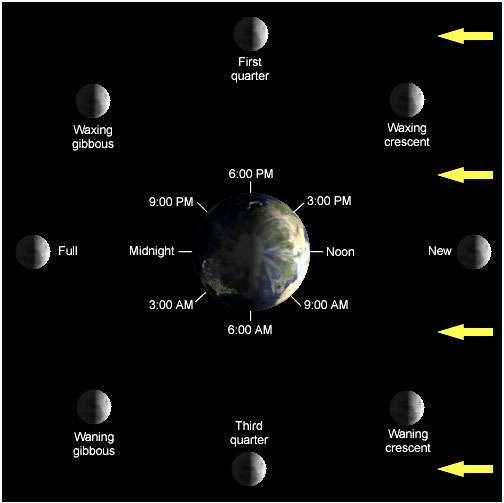
The Earth’s Moon is a great teacher and aid when time for spell work. Depending on the spell to cast, be sure to aim it in harmony with the cycles of the moon to achieve the most effective results. The Moon has three aspects: the Waxing, New or Growing Moon, Full Moon, Waning, Old or Dying Moon.

New Moon / Waxing Moon
The Moon is waxing and growing. This is known to be a time to plan spells that introduce new beginnings or projects. A new career, house move, job, relationship, any new venture in life. Bring all the newness you want into your life with the powers of the New Moon.

Full Moon
This is a time when the Moon is at its most powerful, and the magic most potent. Performing any positive spell at this time will achieve good results. This is the ideal time for healing, guidance, and completion spells.

Old Moon / Waning Moon
The casting out of the old ways, banishing old habits, smoking, eating habits, the removal of troubles and worries.

(Click image to enlarge.)
FULL MOON

Full moon is a lunar phase that occurs when the Moon is on the opposite side of the Earth from the Sun. More precisely, a full moon occurs when the geocentric apparent longitudes of the Sun and Moon differ by 180 degrees; the Moon is then in opposition with the Sun. At this time, as seen by viewers on Earth, the hemisphere of the Moon that is facing the earth (the near side) is almost fully illuminated by the Sun and appears round. Only during a full moon is the opposite hemisphere of the Moon, which is not visible from Earth (the far side), completely unilluminated.

The average lunar month is about 29.531 days long, so that the full moon falls on either the 14th or 15th of the lunar month in those calendars that start the month on the new moon. In any event, as lunar months are counted in discrete numbers of days, lunar months are said to be either 29 or 30 days long.

Characteristics

Although it takes only 27.322 days on average for the Moon to complete one orbit around the Earth (the sidereal month), as a result of the Earth’s orbital motion around the Sun it requires about two additional days for the Earth, Moon, and Sun to acquire the same relative geometry. So on average the number of days between two similar phases (e.g., between one full moon and the next full moon) is about 29.531 days. This period is referred to as a lunation, lunar month, or synodic month. The actual number of days in a lunation can vary from about 29.272 to 29.833 because the velocities of the Moon and of the Earth are not constant in their elliptic orbits, and because of gravitational interactions with other bodies in the solar system.

Because the month of February has only 28 days (or 29 in a leap year), there have been a few occasions during which this month has been without a full moon. In particular, there was no full moon in February of 1866, 1885, 1915, 1934, 1961 or 1999. There will be no full moon during February of 2018. In these years, there were instead either two full moons in January, March, or both (as in 1999). In the leap year of 1972, there was a full moon on February 29. The previous February 29 full moon occurred in 1820 and before that in 1752.

A full moon is often thought of as an event of a full night’s duration. This is somewhat misleading, as the Moon seen from Earth is continuously becoming larger or smaller (though much too slowly to notice with the naked eye). Its absolute maximum size occurs at the moment expansion has stopped, and when graphed, its tangent slope is zero. For any given location, about half of these absolute maximum full moons will be potentially visible, as the other half occur during the day, when the full moon is below the horizon. Many almanacs list full moons not just by date, but by their exact time as well (usually in GMT). Typical monthly calendars which include phases of the moon may be off by one day if intended for use in a different time zone.

The date and time of a specific full moon (assuming a circular orbit) can be calculated from the equation:

where D is the number of days since 1 January 2000 00:00:00 UTC, and N is an integer number of full moons, starting with 0 for the first full moon of the year 2000. The true time of a full moon may differ from this approximation by up to about 14.5 hours as a result of the non-circularity of the moon’s orbit. The age and apparent size of the full moon vary in a cycle of just under 14 synodic months, which has been referred to as a full moon cycle.

Full moons are generally a poor time to conduct astronomical observations, since the bright reflected sunlight from the moon overwhelms the dimmer light from stars.

FolkLore

Full Moons are traditionally associated with temporal insomnia, insanity (hence the terms lunacy and lunatic) and various “magical phenomena” such as lycanthropy.

Many neopagans hold a monthly ritual called an Esbat at each full moon, while some people practicing traditional Chinese religions prepare their ritual offerings to their ancestors and deities on every full and new moon.

Calendars

The Hindu, Thai, Hebrew, Islamic, Tibetan, Mayan, Neo-pagan, Celtic, and the traditional Chinese calendars are all based on the phases of the Moon. None of these calendars, however, begin their months with the full moon. In the Chinese, Jewish, Thai and some Hindu calendars, the full moon always occurs in the middle of a month.

In the Gregorian calendar, the date of Easter is the first Sunday after the ecclesiastical full moon which occurs after the ecclesiastical vernal equinox. In this context, the date of the full moon (together with the date of the vernal equinox) is calculated not according to actual astronomical phenomena, but according to a calendrical approximation of these phenomena.

In the Chinese calendar, the Mid-Autumn Festival falls on the full moon of the eighth month, whereas the Lantern Festival falls on the first full moon of the year.

Full Moon Names

It is traditional to assign special names to each full moon of the year, although the rule for determining which name will be assigned has changed over time (see article at blue moon). An ancient method of assigning names is based upon seasons and quarters of the year. For instance, the Egg Moon (the full moon before Easter) would be the first moon after March 21st, and the Lenten Moon would be the last moon on or before March 21st. Modern practice, however, is to assign the traditional names based on the Gregorian calendar month in which the full moon falls. This method frequently results in the same name as the older method would, and is far more convenient to use.

The following table gives the traditional English names for each month’s full moon, the names given by Native Americans in the northern and eastern United States, other common names, and Hindu names. Note that purnima or pornima is Hindi for full moon, which has also become the Malay word for full moon purnama.
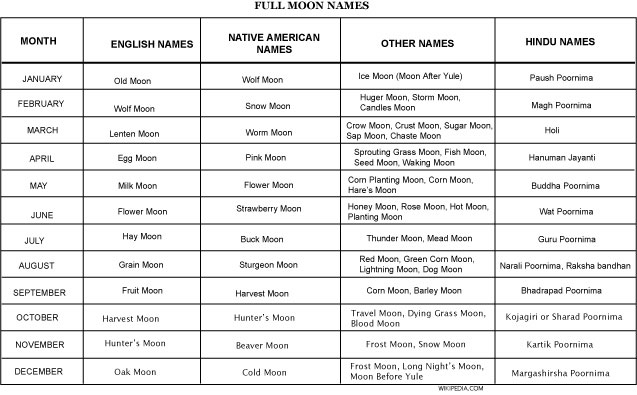

(Click image to enlarge.)