Hot Summer Days

Summer has arrived, and the hot and sweaty days are great to help the body remove toxins and cleanse itself of impurities. Have you noticed that we tend to eat less in summer? The hot energy of the body is definitely stronger during the summer keeping the body vital and energized, needing less food. During the cold winter days the body uses the energy of the food we ingest to create more vital energy to store. So let’s welcome the natural purification process and enjoy the Sun’s vitality.
Have you ever wondered where the old saying: dog days of summer comes from? .. well these hot days from early July through August and part of September are named after the “Dog Star”, Sirius. During the first 5 days of the month of July Sirius rises in the sky and sets in conjunction with the majestic Sun, astronomers call this phenomenon “helical”, which comes from Helios –rising and setting.
Since the ancient times of Egypt, Sirius has been known as the Nile Star or Star of Isis. About 5,000 years ago the rising of such star marked the flooding of the Nile River. The story indicates that the statue of Isis, at the Dendera temple, had a precious jewel in her forehead, and when the light of the Star of Sirius hit the jewel, the flooding began.
The etymology of the word Sirius may originate from various places: the Egyptian word sihor, which means Nile, or from the Greek word seirios, which translates scorching. The Romans knew it as Canicula, because the location of this star is in the constellation Canis Major, which could translate “the big dog”. To the Romans, the hot energy-waves of this phenomenon drove men and dogs mad, and called these blazing hot days caniculares. In the sixteenth century the translation of this Latin word to English was “dog days”.
The Sirius star has become a big part of the history of the Cosmos. It is one of the brightest stars in the sky and can be easily seen with the naked eye. To the Norse it was known as Loki’s Brand. The Dogon tribe, in Africa, believe Sirius B (the small companion of the larger Sirius A) to be the navel of the Universe and home to the mysterious race known as the Nommo.

The Pleiades, a cluster of seven stars found in the Taurean constellation also show themselves during these dog days of summer, just ahead of the Sun, when we look towards the east-norht-east horizon. This group of stars is only one million years old, when our precious dinosaurs walked the green Earth. To the Greek the Pleiades were known as the Seven Sisters: Alcyone, Asterope, Celaeno, Dryope (also Merope or Aero), Electra, Maia, Taygete. Daughters of Pleione and Atlas, the Titan who held the world. This is what has given them the name Atlantides. The story says that one beautiful day, the hunter Orion saw Pleiades walking the countryside and mesmerized by their glow wanted them for himself. For seven years he tried to win them over, until Zeus turned them into stars, as they have so persistently asked for.
In some cultures, the appearance of these stars signaled the beginning of the new year. To the Vikings, the Pleiades were known as Freya’s Hens, to the Maori they were known as the Mataariki, to the Australian they are the Makara, and to the Japanese they are the Subaru … which is the reason why the world known car company uses them in their logo.
To the Native American, as well as the Greeks, the Pleiades were also known to be a vision test, the number of stars you could see determined the sharpness of your eyesight.

sunflowers

Summertime Is Magic Time!

by Ellen Dugan

sunflowers

The season of summer is upon us now, the garden is in full swing, so why not take advantage of the flowers and plants that are available to us and work a little magic with the spirits of nature and the tides of the Moon as we celebrate this lush and fertile season of summer. We have three prime days for summertime magic this month: the Flower Moon on June 18, the Summer Solstice on June 20, and the old Mid-summer’s Eve, which is celebrated at dusk in June 24.
For a Flower Moon celebration you can easily incorporate any white of pink blooming flowers in the garden.
The rose is a prime flower for summer magic – some traditions even call the June Full Moon the Rose Moon. Try white roses to honor the Moon and the Lady, pink roses to promote friendship and gentle affection, or red roses to work a sultry summertime spell for love.

A Full Moon Love Spell

Work the following Full Moon spell outdoors. Sprinkle some fresh rose petals all around you in a circle. Use white petals to honor the Moon Goddess -and the Fairies, red for desire and passion, and pink petals for the fun and joy of being in a romantic relationship.
Repeat the following verse, and save a handful of petals to close out the spell:

On this, the longest night of the Full Flower Moon,
I ask the Goddess to grant me a boon.
White flower petals for the Lady, and red petals for desire,
Pink petals for joy and the fun they inspire.
Now increase romance, send loving passion to me,
By rose petals and the power of three times three.
As I will, so let it be!

Now look up to the Full Moon, blow the Goddess a kiss, and toss the remaining rose petals up as high as you can. Leave the petals where they fall, and know that romance is on its way.

A Summer Solstice Celebration

To celebrate the Summer Solstice, try working with the cheerful sunflower. Just as you’d expect, this flower has the planetary aspects of the Sun, and in the language of flowers it symbolizes success, fame and riches. Imagine a Sabbat celebration with golden candles and tall stems of yellow sunflowers arranged across the work area. Light the golden candles and turn to face the Sun. Announce out loud your goals for a successful life. Then repeat the following verse three times:

On this, the longest day and shortest night,
O work to bring my hopes and dreams to light.
Like a golden sunflower, I turn to face the Sun,
Grant me success and happiness, and let it harm none.

Allow the candles to burn in a safe place until they go out on their own. Let the sunflowers dry out and then let the birds have the seeds as a snack.

Ritual for Midsummer’s Eve

For Midsummer’s Eve, you could try your hand at fairy magic. Faeries love fragrant flowers like roses and blooming herbs. And don’t forget those ferns! Ferns are sacred to the fairy folk, and adding a few fern fronds to your Midsummer bouquets is a sure way to honor the power of the fairy kingdom. Daisies, yarrows and lavender should be blooming now, so put those blossoms together and weave a little flower fascination for good luck and prosperity in the coming year. Create a small flower bouquet and tie it together with pretty ribbons.
Now take the fairy bouquet and go to a place in nature, and repeat the following charm:

At this time of Midsummer’s Eve, the Fae are all around,
On this ancient day, it’s said, fairy magic shall be found.
This bouquet a;; wrapped in ferns, I offer you as a token,
Grant my request for good luck and health, as this charm is spoken.

Be sure to leave that little bouquet outdoors for the fairies. Allow nature to reclaim it.

Have a magical summer!!

Goddess Flora of Beltane

by Gail Wood

The bright, joyful, birthing energy of spring blossoms into vigorous excitement in the month of May and the holiday of Beltane. The newness of life bursts into eager exuberance. The world is growing, stretching, and reaching out to find wild, extravagant love and erotic sensation. It is the perfection of being in the moment, a time of happiness and fervor.
The rythm of our bodies and hearts instinctively feel the tempo of the wild universe, which opens its arms and embraces us as we flow in with laughter and joy. The perfect, unalloyed pleasure of being is the Beltane state of mind. We flow into this state of mind when we dance in harmony with the ecstatic universe. We let go of our petty selves and step into that flow of harmonious union to become ecstatic ourselves. We embrace our wildness.
Often, it’s difficult for us to emerge as ecstatic, wild, nature beings. One avenue to emergence is to celebrate a deity. Flora, the Roman goddess of springtime and flowering vegetation, is a good choice for the Beltane state of mind. She is the patroness of everything that grows and flourishes: flowers, plants, trees and vines. Her festival, Floralia, was celebrated from April 28 to May 3, and in a rose festival on May 23, though much of the orgiastic celebrations were eventually outlawed. Nevertheless, we can find her ecstatic magic in our bodies and in the blooming flowers.

Begin by creating a sacred space, decorating with flowers, bright-colored fabrics, and light foods made with honey, beans, grains, vegetables, and/or flowers. Leave space to move and dance. Take a deep breath and connect with the energy of Mother Earth, creating a feeling of safety and security. Close your eyes and eagerly call the goddess Flora into your circle.

“Lady of flowers, Lady of spring
Dance into my life and sweet passion bring.
Flora, goddess of all energy growing,Be here now, aid our vibrant knowing!
Hail and welcome!”

As these words echo in your body, feel the presence of goddess Flora before you. Gaze at her and drink in her flowering beauty, and feel the flourishing power of her presence. As you breathe deeply, breathe in the aura of her. She may sing or speak to you.
See her open her arms to youin an embrace. Feel the flow of energy inviting you as you move forward to merge with her. As you join together, feel the power of blossoming growth and feel yourself covered in flowers and vines. You are the flowering goddess. Breathe in this magic.
As you breathe in, feel the ecstatic energy of the universe fill you. As you breathe in, feel the need to move and dance. Dance the Flora within you. Give voice to her song and give movement to her essence. Go wild and feel her ecstasy as you dance, growing, flowering, thriving, living the erotic life. Let the excitement take you and move your body.
When it is time, take a deep breath. Eat and drink a little to ground and solidify the mystery you have just experienced. Then, close your eyes and feel the goddess inside your being. Her eyes tell you it is time to go, and gently she moves outside of you. With a final farewell, she is gone from your circle as you say:

“Fare-thee-well, Flora, goddess of spring.
Memories of Beltane will remain
No matter what else this year willbring.
Your flowers and vines will always remind-
Not just a holiday, a state of mind!
Go with joyful thanks and wild blessings,
Hail and farewell.”

beltane dance

The Celebration of Beltane

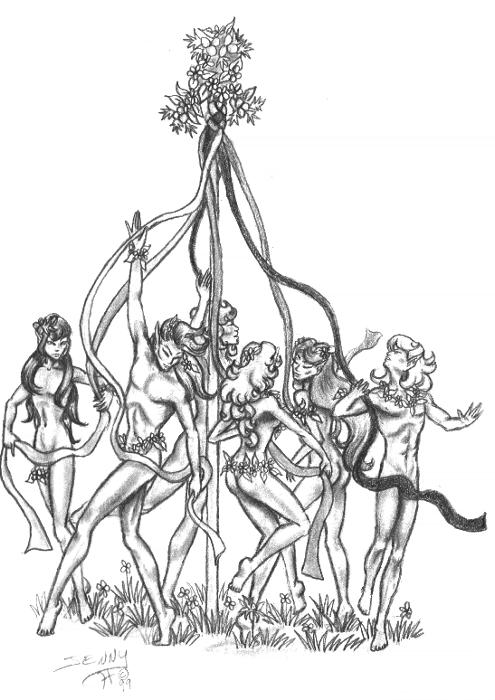
Beltane is the sensual Pagan festival of fire and fertility, also known as May Day — when we dance around the omnipotent phallic symbol, the maypole. The red and white ribbons woven around the maypole represent blood and semen; the sacred fusion of female and male energies that are the creative life force.
Capture the essence of this potent fertility celebration by weaving or plaiting red and white cord or ribon. Leave some loose, unplaited ribbon at the end to cut later. Wear your woven cord as a headdress or place onto your altar in a heart shape. Head wreaths were traditionally worn at Beltane to honor the Queen of May.
If you are single, to attract a partner, grab a red pen and a piece of white paper and write the qualities you admire in a lover. If you are in a relationship, list what you enjoy about your partner, plus a few traits you may wish to nurture. Then add what you love about yourself. Roll up the piece of paper and tie with the leftover red and white ribbon. Place it under your pillow as you sleep this night, thinking about the joy your partner, or potential partner, will bring. When you wake, store the scroll of paper in a safe place.
–Emely Flak

april bloom

April Fling – A Spring Thing

april bloom

“Enlightenment doesn’t come through constantly seeking after some kind of excitement, but through concentration on making each task in our everyday routine sacred.”

A Poem For April’s New Moon
by Elizabeth Barrette

The Maiden Goddess

The Maiden dances, pale and fair,
On April mornings soft with rain
With apple blossoms in Her hair
And green leaves trailing from Her train.

In pastures thick with silver dew
She stops to bless each calf and cow.
Her duty here is to renew,
A waxing crescent on Her brow.

She sows the sees of things to come
As fresh and innocent as air
But in the distance, summer’s drum
Will beckon Her from here to there.

INSPIRATION FOR THE WITCH IN YOU

APRIL 2008
by Lily Gardner

Small shoots poke up from the ground and tight green buds unfold into leaf and blossom. The air is filled with birdsong. A new April green saturates the landscape and every gardener steals time to be outdoors to cultivate and plant. Whether you’re a gardener or not, April is the perfect time to cultivate a wish garden. What have you wished that seemed beyond your reach? Plant your wish this April, using the four corners of the Witches’ Pyramid as your tools, and see what you can accomplish by harvest time.
Let’s begin with the first corner of the Witch’s Pyramid: to know. I would suggest that you begin a wish-garden journal as a way of focusing your thoughts. Novelist Don DeLillo said, “I don’t know what I think about certain subjects until I sit down and try to write about them.” Write down your thoughts until you’ve come to the place of really knowing your wish.
The next step in the process of “knowing” is brainstorming. Often a wish can be so ambitious as to seem overwhelming. Begin with the large steps necessary to get you from where you are now to where you want to be when you’ve achieved your wish. Break those large steps into smaller, concrete steps that you feel are doable in the present. Write down your specific plan one small step at a time. For example, your wish may involve schooling or learning a new skill, so begin with a list of classes you could take at this time. Visualizing your desire and brainstorming ways to achieve it is analogous to plowing the ground of your wish garden.
As you continue to prepare the groundwork for realizing your wish, consider the next corner of the Witches’ Pyramid: to will. Will is the steadfast resolve you need to reach your goal. Talent will only bring you so far; what you truly need is the passion to continue through fatigue and setbacks. To help build this resolve, I suggest making an altar dedicated to your wish. Find a deity whose special province aligns with your wish, and choose one of the four elements that resonates with your goal. If, for example, your wish is to own a farm, Tara would be a choice for your goddess and earth would be the element that resonates with your goal. Choose colors for cloth and candles that correspond with your wish. Use green for possessions, yellow for a new career, orange for an artistic endeavor, and pink for a committed relationship.
Every morning on awakening and every evening before going to bed, light a candle and pray to your deity to strengthen your will. Journal your progress as you work down the list of concrete steps toward realizing your wish. Each step is a young plant in your wish garden. Think of the obstacles as stones that need to be removed from your garden so the young shoots of your wish can flourish.
The third corner of the Witches’ Pyramid is: to dare. Do you have the confidence to override your own inner critic? The inner critic is that little voice inside that says you can’t possibly achieve your wish: you don’t have the intelligence, time, or talent to accomplish what you set out to do. Prayer, visualizations, and positive affirmations are the nutrients that help build confidence and firm your resolve. Spend time at your altar visualizing yourself living in the center of your wish.
The last corner of the Witches’ Pyramid is: to be silent. Always be cautious about sharing your wishes. Even loved ones may express doubts as to whether you can accomplish your dream, and that only serves to strengthen your inner critic and undermine your progress/ Even more caution is needed when sharing your magical workings. Many Witches believe that his type of sharing actually depletes the energy of your spell. Keeping your energies focused in this way also nourishes your wish.
May the garden of your wishes be fruitful and thrive!

Growing a parsley plant in your kitchen is good for both cooking and to “recycle” negative energy; just make sure you provide it with a deep pot.

April’s Promises: Astrological Update

April showers may bring May flowers and the blooming promise of romance, but — astrologically speaking — this month is almost too hot to handle! Pluto goes retrograde in Capricorn on April 2, focusing your attention on transformation. Mercury enters Aries on April 2, beginning a period of enthusiasm and creativity. Then, lovely Venus follows Mercury into the fiery planet’s influence on April 5 — signaling a time of gallant chivalry and romance. A new Moon follows the first two planet’s lead the very same day, bearing new beginnings. Seize onto this dynamic energy — the month is just starting!

Sun Squares Jupiter on April 10, followed by a sextile to Neptune on April 13, when enthusiasm needs to be tempered with practicality. Also on April 10, Mercury forms a T-square with Mars, followed by a square to Jupiter on April 13. These are passionate transits, so think carefully before you speak!

Things calm down the following week with Mercury entering Taurus and the Sun transiting into the same sign on April 19. A full Moon in Scorpio brings forth intense emotions. However, strength and passion are rewarded now, due the harmonious aspects of the Sun and Moon to Saturn. Embrace them both!

The show is still not over when Venus squares Mars on April 23 — depending on your birth chart, things might either spice up or there will be trouble. When explosions follow Mars moving opposite Jupiter on April 24, you may feel that you drank a glass of rocket fuel. You will be treading water when Mars moves quincunx to nebulous Neptune on April 28. The month closes on steadier ground, as Venus moves into Taurus on April 30. Courtesy of Astrology.com

April’s Special Days

– 1: April Fools’ Day / All Fools Day (Pagan)
– 2: Pluto goes retrograde 5:23 am
– 5: New Moon 11:55 pm
– 14: Celtic Tree Month of alder ends
– 15: Celtic Tree Month of Willow begins
– 18: Juno goes retrograde 8:48 am
– 19: Sun enters Taurus constellation / Passover begins at sundown
– 20: Full Moon 6:25 am (Wind Moon). Moon enters Scorpio 5:00 am / Passover
– 22: Earth Day
– 23: Administrative’s Day
– 25: Arbor Day / Orthodox Good Friday
– 27: Orthodox Easter / Passover ends

holiday altar

Let Your Altar Renew Your Spirit for the Holidays and Beyond

by Sandra Kynes

holiday altar

Your altar is more than just a place to put things. Through the ages, the use of altars has been both communal and private. Although home altars seem more prevalent in certain faiths, in recent years their use has become more widespread regardless of one’s spiritual path. While altars and their purpose have evolved over the millennia, they continue to fulfill a fundamental need that transcends spiritual orientation.

There is a certain power to an altar. It is not just a thing that holds a collection of objects; intention and energy transform an altar into a space that is separate from our everyday world. When we use an altar, we step outside the boundaries of our day-to-day lives. When we sit in front of an altar, we place ourselves in the presence of spirit and open ourselves to receive answers to the questions that guide our souls.

As a central part of ritual and worship, an altar is a place of spiritual encounter. It serves as a reminder of our contact with the Divine as well as contact with our souls. Using an altar strikes a familiar chord within us. We may not understand why this occurs, but we can sense a shift of energy away from ordinary awareness. Altars hold objects of inspiration and devotion, personal and sacred, resulting in a space that visibly and energetically links the spiritual and physical worlds and provides clues to our innermost thoughts and feelings. The Greek word gnosis is usually translated as “knowledge;” however it can also be translated as “insight.” According to Elaine Pagals, “[g]nosis involves an intuitive process of knowing oneself.” 1 An altar becomes a tool for gnosis—knowledge that comes from spiritual insight and self illumination.

In the past, the sacred and secular were not so rigidly segregated. This is not the case in today’s world; however, having a place where these aspects of our lives come together can be a means for finding balance. This meeting point of spiritual and mundane energies can provide an orientation or anchor in the world—a place to hold onto and come back to for personal strength and exploration. The things that we place on an altar become symbolic of what is going on in our hearts and minds. Because of the convergent energies, an altar is not a passive space—there is constant interaction.

In addition to providing a place for worship, an altar functions as a tool for exploration and growth. Like a labyrinth, an altar top itself can act as a “blueprint for the psyche to meet the soul.”2 An altar is a place where you lay out your intentions—put your cards on the table, so to speak—to manifest particular energies into your life. In describing how Peruvian shamans interact with their altars, Jim DeKorne said that the altar top functioned like a “game board, a symbolic paradigm against which the ritual is played.”3

This is the premise of my book, Your Altar; using the altar as a game board—for lack of a better term. The phrase “game board” is not meant to be irreverent. It’s a way to convey the concept of a matrix or setup for an altar and a different form of meditation practice. While it is standard practice to use an altar for focus, it can be used as an integral part of the meditation technique. Dividing the altar top into multiple sections and using them to focus a flow of thoughts allows the altar to function as a powerful and symbolic tool not unlike a Buddhist mandala, classical Christian icon or Hindu yantra.

When we create any type of matrix we bring the power of numbers into play. The ancient philosopher and mathematician Pythagoras believed that “the essence of everything seemed to be expressible in numbers.”4 He further developed his theology of numbers and ascribed symbolic meanings to numbers, which formed the basis for the practice of numerology. In many cultures and spiritual traditions, the notion of sacred numbers provides a means for dealing with the great mysteries that confront us on a spiritual level.

When numbers are used symbolically, they can reveal underlying energy, purpose, pattern, and structure. According to Annemarie Schimmel, a number “develops a special character, a mystique of its own, and a special metaphysical meaning.”5 Within an altar matrix, numbers serve as yantras—geometric diagrams for focusing the mind and accessing our numinous souls.

This is especially important during this manic time of year, when consumerism kicks into high gear and we rush frantically like hamsters on our materialistic treadmills bemoaning the fact that we are so busy. This is the perfect time to turn to our altars to reconnect with the meaning of the holiday season as well as with ourselves. However, with so much to do and so much on our minds, it may seem like an impossible task to sit and bring our chattering monkey brains to rest for even a few minutes. This is when using the altar itself as a tool can aid us. As a tool, we use it to guide a flow of thoughts that will allow us to step out of the everyday experience.

For a holiday meditation we use a three-part altar, which means that we divide the altar top into three sections. Since it is the holiday season, you can take a long strand of garland, cut two pieces as wide as your altar and then lay them across the altar top, creating three fairly equal-sized sections that run vertically to where you will sit. This does not have to be a difficult mathematical project where the sections need to be exact down to the millimeter. As long as the sections look fairly equal to you, that’s all that matters.

Three is a number that was significant to the ancient Greeks, Egyptians, and Celts. It is significant in Buddhism, Christianity, Hinduism, and Paganism. Three, a triad, represents a new unity that does not discard the polarity of two but integrates it into a new wholeness. A three-part altar provides variety and complexity. This is a complex time of year when we look at the past as well ahead to the future. The component that is usually missing in these musings is the now—the purpose of this season and how we experience it.

With your altar top divided, it’s time to set the intent. The section on the left represents you. Place things in this section that represent meaningful events and milestones that occurred in the past year that have played a part in who you are at this moment. For the center section think about what the season means to you. Is it a time when you feel most connected with your spirituality and feel a connection with the Divine? A figurine of baby Jesus, an angel, a goddess statue, or the word “Peace” on a slip of paper may be objects that are appropriate for you. In the right section, place a candle, and a picture of the sun or anything that is luminous or represents renewal.

Once you have set up your altar, sit comfortably in front of it and close your eyes for a couple of minutes so you can begin the shift from your everyday outer world to your interior space. Focus on your breathing and let each slow breath start from your belly. Become aware of your contact with the floor—feet or sits bones—and think of your energy reaching down to touch Mother Earth. Feel the solid foundation of the earth and then draw this energy up and into your body. As you continue to draw the energy up to your abdomen, your center, feel the energy lighten into water. Continue to draw this energy up to your chest, to your heart. Feel the spark of fire energy burn with the passion of life. As the energy continues upward, feel air energy, the power of the mind and wisdom, surround your head. Hold the sensation of all four elements for a moment and then allow the energy to return to Mother Earth, taking any negativity or tension from you as it recedes.

When you are ready, slowly open your eyes and with a soft gaze look at the object(s) in the left section of your altar. Instead of replaying events in your mind, try to capture the essence of the past year and come to a sense of self. This may be slightly more difficult than it sounds because our true selves are not about what we have or what we do for a living. Try to just be, and then feel what comes to you—without judgment—just be for a few minutes.

When you feel that you have reached that point, or at least gotten as close to it as you can for now, allow your gaze to gently shift to the center section of your altar. Underneath all the modern trappings, contemplate what this season means to you. Seek what is in your heart and know that the magic of this season lies within your soul.

Finally, shift your gaze to the right section of your altar. We celebrate the light: the sun beginning its journey back to us, the (re)birth of the divine, and the renewed light of spirit in our hearts. In your mind’s eye, see light emanating from your heart center, surrounding you and then moving out into the world. Allow the image to fade of its own accord, and then slowly bring your focus back into the room where you are sitting. Hold any sensations for a moment or two and then let them go.

You may have a moving experience or you may simply feel more relaxed. It’s not important to hear a choir of angelic voices. The most significant aspect of this particular meditation is to step out of the frantic whirl of activity that we force on ourselves and into the realm of spirit where we can catch our breath and put life into perspective. Altar experiences will vary, but each one will be its own unique journey.

After working with an altar setup, leave it in place for a day or two; the visual clues that guided the meditation will serve as reminders to keep ourselves grounded in the things that are important.

By using an altar we participate in an ancient act that is fundamental to humankind. The way that we interact with our altars is as diverse as we are as individuals. Using the altar as a tool for introspection serves to enrich our spiritual paths and deepen our sense of self. Repeat the meditation several times during the holidays and see if it makes a difference in your experience this year. The joy of the season resides in our hearts; we just need to pause for a while to find it.
1Elaine Pagals, The Gnostic Gospels, p. xix.
2Dr. Lauren Artress, Walking a Sacred Path, p. 147.
3Jim De Korne, Psychedelic Shamanism, p. 139.
4Annemarie Schimmel, The Mystery of Numbers, p. 11.
5Ibid, p. 16.

______________________________________________________
This page is purely for the educational fulfillment of LoveDriven’s kind visitors.

Click here to visit the article in Llewellyn.

In Celebration of the Winter Solstice

Lets celebrate the season!

The Winter Solstice – Marking the beginning of the Wheel of the Year

The month of November is a time of transition all over the world. In the Northern Hemisphere, we think of the Earth preparing for the sleep of winter, people preparing for bundling up and drinking cocoa. The final harvest is in, trees are dropping their leaves, and animals are looking over their goods in preparation for winter. Traditionally it is a time to start turning inward, to study, it is a time of withdrawal.
In the Southern Hemisphere, however, summer is approaching. The Earth has awakened from the winter’s rest, vegetation is blooming where it’s supposed to bloom, and people are peeling off the winter layers in preparation for warmth and light. It’s a time of moving forward, expansion, and community.
Contemplate for a moment on the marvelous stability the Earth holds as the two hemispheres balance each other. The Earth is performing its own seasonal yin-yang, and this encourages more magic! (Cerridwen Iris Shea)

~ ~ ~Wear honeysuckle oil to enhance your power and communication.~ ~ ~

Blazing hearths, flickering candles, warm smiles, and generosity are the essence of December. This is a time to remember what is most cherished. It’s a time of reaching out to others and reaching inside ourselves. We are reminded to connect with our own humanity and gentlest strengths. December celebrations focus on generosity, family, friendship, and kindness to strangers. Our spirits are lightened, enriched, and renewed by the month’s winter celebrations.
Memory and traditions sparkle brightly in December, bringing out the best in us all. Enjoy the special magic of this month with good food and the singing of carols, chanting around the Yule log, drumming, dancing, and rejoicing! This is a holiday season rich in many different joyous sounds and scents. (Abby Willowroot)

December is the month of the Winter Solstice, and birth month of many gods/deities, especially the gods of the Sun. Mithras is a god whose birth-date is in December. Mithras was a god worshipped in Rome during the period of 200 bc through 394 ad, when the Christian Emperor Theodosius declared Paganism to be illegal. Some believed that Mithraism continued in the Alps and Vosges until the 5th century.
In Italy there is the celebration of Befana, the Witch of Christmas, who flies through the air on her broom giving presents to all the good boys and girls. This thousand year old legend is still celebrated today in different parts of the world … with a twist!

The name December comes from the Latin word for the number “ten”, because it use to be the tenth month, but later on when two other months were added, December became the twelfth month. It was named for Decima, the goddess of childbirth. With Nona and Morta she forms Parcae -the three Fates.

Hanukkah– begins at sundown December 16th. A “Festival of Light”. Hanukkah commemorates Jewish traditions and history. It is a joyous celebration of the family and community. A candle on the menorah (candleholder) is lit on each of Hanukkah’s eight days. Friends and family join together in celebration with traditional foods, songs, and stories. Children play games with the dreidel (a four-sided spinning top) and sing the dreidel song. Gifts and gelt (gold candy coins) are often given, especially to children.

Yule– December 21. A lively winter celebration marking the return of the Sun. Traditional Yule symbols include mistletoe, pine boughs, ivy, and lights. The burning of the Yule log represents the Green Man’s sacrifice and ensures abundance in the coming year. The log’s remaining ashes are scattered in the fields to ensure good crops in the coming year. Yule is also a time of sacred wells, streams, and water. Reverence for earth, fire, and water at Yule shows the deep spiritual connection between the people and the land. It is especially good luck to drink the “first waters” of Yule’s growing light.

** For a Yule/Winter Solstice Ritual visit Divine Muse’s Pure Awakenings at: Winter Solstice Ritual

Christmas– December 25. To Christians, it is the birthday of Jesus. To others it’s a winter festival. The holiday is celebrated with songs, stories, traditional foods, Santa Claus, gifts, children’s smiles, and religious services. Many Christmas customs are borrowed from earlier Pagan ones, like the decorating of evergreen trees, giving gifts, kissing under the mistletoe, sleighs, reindeers, the holly, and hanging stockings.
In China, Japan and India, Christmas is celebrated with decorated trees, paper lanterns, flowers, fireworks, and gifts, especially money gifts for prosperity from the elders to the young ones. In Mexico and other South American countries a Posada or Nativity is reenacted.
“Feliz Navidad”, “Natale Allegro”, “Joyeux Noël”, “Frohe Weihnachten”, and “Vrolijke Kertmis” are just a few of the many ways people say Merry Christmas!

Kwanzaa– December 26 to January 1. Kwanzaa is not specifically political or religious, but it is deeply spiritual. It was begun in 1966 by Dr. Maulana Karenga and is the newest of the major winter holidays. This holiday is based on Nguzo Saba, the seven guiding principles of Kwanzaa, which are unity, self determination, collective work and responsibility, economic cooperation, purpose, creativity, and faith. The popularity of this joyous and solemn holiday has quickly spread around the world. Kwanzaa honors the spirit, accomplishments, talents, and ethics of all people of African descent.

Important dates and events for the month of December

– December 3, 2006: Christian: Advent, start of holy season ending with Christmas.

– December 4, 2006: Full Long Night Moon 7:25 pm est

– December 8, 2006: Buddhism: Bodhi Day, day of enlightenment of Buddha. / Roman Catholic: Celebration of the Immaculate Conception of Mary, mother of Jesus. Light a white candle in Her name.

– December 15, 2006: Jewish: Hanukkah, Festival of Lights or Festival of Rededication, begins at sundown.

– December 13, 2006: Roman Catholic: St Lucy Day, protector from the evil eye, and to conquer temptations. Light a white candle in her name.

– December 17, 2006: Roman: Beggining of Saturnalia, celebrating dedication of temple of Saturn. / Roman Catholic: St Lazarus, patron saint of the sick, and problems with drug addictions, to maintain health. Light a yellow candle in his name.

– December 20, 2006: New Moon 9:01 am est

– December 21, 2006: Winter Solstice at 7:22 pm est Sun enters Capricorn. / Wiccan/Pagan: Yule, celebration of winter solstice and return of the sun.

– December 23, 2006: Jewish: Hanukkah ends.

– December 24, 2006: Celtic Tree Month of Birch begins. Welcome the gift of birch essence into your home and incorporate it into your craft. / Christian: Christmas Eve, the night when Mary and Joseph traveled searching for a place to rest and give birth to Jesus.

– December 25, 2006: Christian: Christmas Day, celebration of the birth of Jesus. / Egyptian: celebrate the birth of Heru (Horus) the child of Aset (Isis). / Mithraism: birthday of the Sun god Mithras.

– December 26, 2006: Kwanzaa begins, celebrates the African-American people, their ancestors, culture, and values. / Egyptian: Feast of the goddess Neith. / Zoroastrian: (Mazdaism; Mazdayasna; Persian) Death of Prophet Zarathustra.

– December 30, 2006: Islam: Id-al-Adha, celebration of the completion of the hajj (pilgrimage) at Mina, Saudi Arabia.

– December 31, 2006: New Year’s Eve, celebrates the last day of the gregorian year of 2006.

~ ~ ~Garnet is associated with welf-confidence, success, and popularity. Give a Garnet stone to a friend who has earned a promotion.~ ~ ~

The Festivities Commence

Lets celebrate the season!

The year is waning, the season of silence is at hand. We have at last shed the heaviness of the dying year, and all that remains is one last step, one step that is a thousand miles, across the threshold of the underworld. She is smiling: “I have been waiting for you”.
The Crone holds one hand out to us in light, and the other in shadow. One turns around the other, and together they bring balance to the wheel of the year: without the release of nightfall, the light of summer would blind us, and without the promise of dawn, the path would be overgrown with fear. To truly become whole as Witches and as human beings, we must learn to dance the edges of being, to balance waxing and waning within ourselves as the Earth finds a balance of her own.
October is the last breath of the year, almost a sigh –of contentment for some, of sorrow for others. Look back over the turning of the wheel gone by: what did you set out to do, and what was done? Most of us have words unsaid, goals unmet, and we live with disappointment in ourselves and guilt over the path not taken. We cling to our failures much more readily than we cling to success.
Holding on, however, is not the nature of autumn. This is the season of letting go–of life, of light, of the year just past. Nothing in nature can stay the same forever, and we are certainly not the exception to that rule. The more of the past we carry on our shoulders, the harder it is to walk upright, and eventually we are crushed beneath the weight of our own refusal to grow. The lesson of October, as the year takes its final bow, is that all things are born in the Mother, and all return to her in time.
Autumn is also the season of memory, a time to honor those who have passed through the veil and into a new life. Though we must let go of the past, and allow those we have lost to move on as we do the same, it is vital to keep the memories and lessons alive. What good was the sacrifice of the grain if we let it rot in the fields instead of baking bread?
Years ago I learned a ritual from a dear friend and fellow priestess that became a Samhain tradition. For ritual details visit Divine Muse’s Pure Awakenings: Samhain Release Ritual
The Crone Goddess may wear a terrible face, but she is not to be feared. Hers is the darkness of sleep and dreams, of one life yielding to the next as autumn turns to winter turns to spring. Give her your sorrow, and she will transform it into promise; give her your tears, and with them she will water the coming year. Life, she teaches, is meant to be lived–it is beautiful and terrible, temporary yet everlasting. Walk from one year to the next with hard-earned knowledge, and without regret.
This time of year, when the first chill of winter coaxes the leaves from the trees, turn within to find the solace you seek. Allow the Dark Lady to lead you down the spiral path, around the hills where the Wild Hunt will soon run, away from cricket-song and far from the madding crowd, to the loving embrace of the silent Earth … from whose arms, come spring, you will emerge again renewed.
–by Dianne Sylvan

** For a Samhain Ritual visit Divine Muse’s Pure Awakenings at: Samhain Ritual for a Coven or the Solitary Witch

More about October
In October, crops are being gathered and the ancients gave their gratitude to the Gods of the grain and green growing things for Their gifts. This wonderful season was a time of celebration with many festivals. One was the Nubaigai in Lithuania, where the Corn Goddess was celebrated by taking the last sheaf of grain and dressing it up like an old woman (the Nubaigai), which to many the crone was thought of as a Witch. The festival had a wide range and variety of food, drinks, games and dance. During the festivities, the harvest wreath was carried out on a white cloth as the people sang traditional songs about it’s rescue from a bison trying to eat it.

HALLOWEEN
Modern Wiccans celebrate Samhain at the time of Halloween. Samhain, pronounced “sow-in”, meaning “Summer’s End”. This holiday is a celebration of the spirits of their ancestors. It is also the last harvest, which brings us right back to harvest, again!
Nowadays this holiday is treated as a secular holiday, but it comes from the name “All Hallow’s Even” or “All Hallow’s Eve” (or all hallows evening), the evening before All Hallows Day. In 609ce, on this day, Pope Boniface IV dedicated the Pantheon, a pagan temple in Rome to the Virgin Mary. A century later, Pope Gregory III moved the holiday to November 1st.

Important dates and events for the month of October

October 2, 2006:
— Hinduism: Dussehra/Durga Puja, Festival celebrating victory of good over evil.
— Jewish: Yom Kippur, Day of Atonement

October 4, 2006:
— St Francis of Assisi day. Patron of animals, birds firemen, merchants, needle workers, and solitary death.

October 5, 2006:
— Lithuania: Nubaigai, Festival of the Old Crone celebrating the Corn Goddess.
— Japan: Daruma, anniversary of the death of Bodhidharma, founder of Zen Buddhism

October 6, 2006:
— Full Blood Moon 11:13 PM, EDT. Dr. Willix’s next full moon Fire Ceremony will be on SUNDAY EVENING, OCTOBER 8TH at 7:00PM. Fire Ceremony will be held at the FOUR MEDICINE RETREAT CENTER in Jupiter. Directions available upon request, if interested.

October9, 2006:
— St Cipriano day. History says this saint was raised in black magic before converting to Christianity. Patron of travelers, the homeless, and protector from natural disasters.

October 20, 2006:
— Islam: Lailat-Ul-Qadr, the Night of Power. When prophet Muhammad had a revelation of the Qu’ran

October 22, 2006:
— New Moon 11:14 AM, EDT. Dr. Willix’s next new moon ceremony will be at QUIET WATERS PARK, date and time to be advised.
— Start of Interfaith Week

October 23, 2006:
— Sun enters Scorpio

October 24, 2006:
— National Oriental Medicine day

October 28, 2006:
— St’ Jude day. Patron of hopeless and impossible cases.
— Celtic Tree Month of Reed begins

October 29, 2006:
— Daylight Saving Time ends at 2:00 am

October 30, 2006:
— Chinese: Festival of Hungry Ghosts, Chung Yuan, Large paper bpats are burnt at temples to help spirits on their way

October 31. 2006:
— Wiccan: Samhain, last harvest festival and celebration of ancestors.

Wearing dark blue protects your emotions and discourages unwanted personal comments.